
The Promise of HOPE
By Sarah Achenbach ’88
 An internal earthquake. That’s how Berna Hamill-Guzman ’29 describes her first year at Hollins University.
“Everything I knew about myself and what I wanted and believed in crumbled when I came to Hollins,” she says. “I realized there is so much more for me. Hollins has given me opportunities to grow and change.”
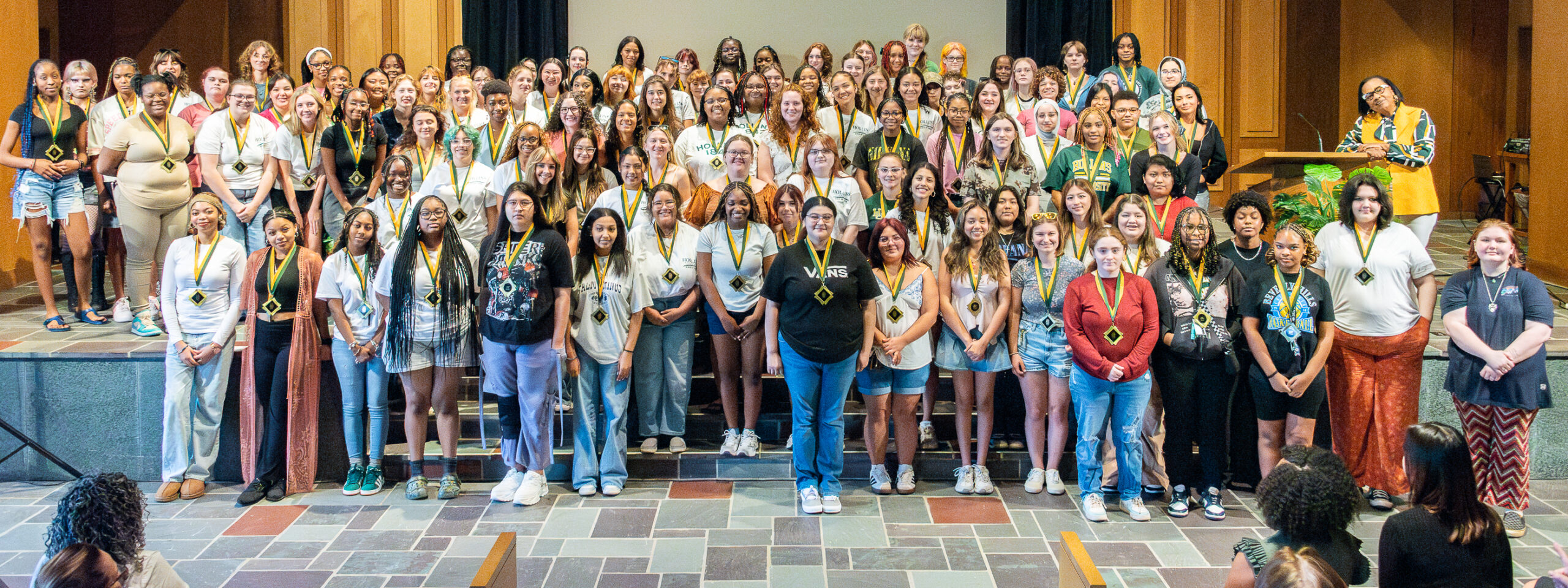
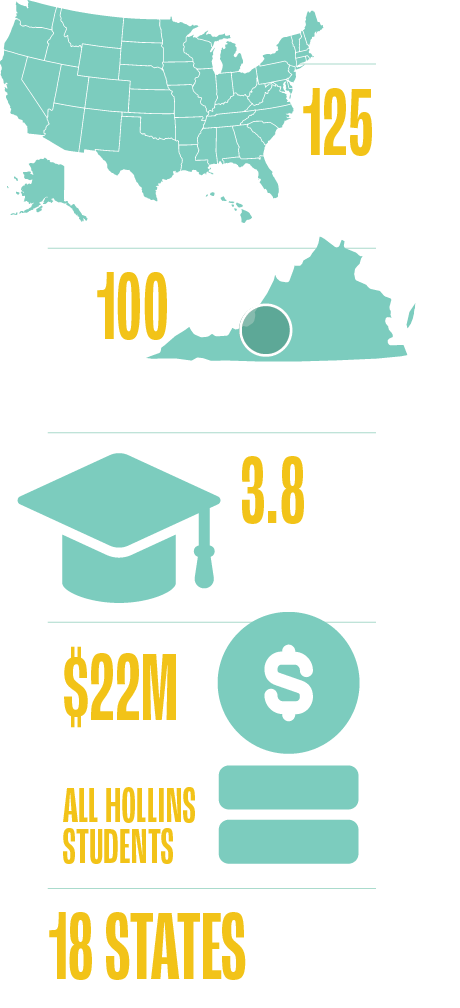
Hamill-Guzman is one of 125 national Hollins Opportunity for Promise through Education (HOPE) scholars in the class of 2029. Just weeks before her first semester, she was living in Easley, South Carolina, working two jobs to close a $3,000 gap between her scholarship and the cost of attending another college. As the first in her family to graduate high school and attend college, that balance might as well have been $3 million.
Her challenge wasn’t talent or ambition. With a teaching internship already completed and dreams of becoming a history teacher, Hamill-Guzman was ready for college. What threatened to derail her plans was the cost.
When she couldn’t close the gap, she assumed her college dreams were over. Then she remembered several emails about Hollins’ national HOPE program. The national program, launched in 2025, covers tuition, on-campus food and housing, and required fees for four years, completely loan-free, to academically talented students from limited-income backgrounds.
Hamill-Guzman applied after the deadline. A coveted spot opened. By the end of August, she was unpacking her future at Hollins.
“With HOPE, I realized college was possible,” she says. Now majoring in history with a minor in secondary education — and considering additional minors — she adds, “It’s the best thing ever, not having to worry about debt.”
For President Mary Dana Hinton, stories like Hamill-Guzman’s are both deeply personal and powerfully familiar.
Hinton, too, was a bright student with enormous potential but no clear path to pay for college. The family that employed her mother as a housekeeper in rural North Carolina offered to fund Hinton’s education. “I had no idea what the world had to offer until I had the opportunity to receive an excellent education,” she says. “Many people never discover their full potential because their world and their view of themselves have been narrowed by circumstances often beyond their control. The only difference between HOPE scholars and other Hollins students is an economic one.”
FROM REGIONAL ROOTS TO NATIONAL REACH
 At a time when doors are closing for many young women of talent and ambition, Hollins has chosen to open them wider.
Inspired by its founding mission to educate women to lead lives of purpose and emboldened by its Board of Trustees, Hollins launched HOPE in 2021 with a regional scholarship serving students from the Roanoke Valley with household incomes of $50,000 or less. The program filled the last-dollar gap after federal, state, and institutional aid, guaranteeing a tuition-free Hollins education. While it did not yet cover additional expenses like room and board, the impact was immediate. Enrollment and retention exceeded expectations, with cohorts of more than 30 students enrolling and persisting at above-average rates. Today, nearly 100 regional HOPE scholars are on campus, with the first cohort graduating this May.
Many people never discover their full potential because their world and their view of themselves have been narrowed by circumstances often beyond their control. The only difference between HOPE scholars and other Hollins students is an economic one.
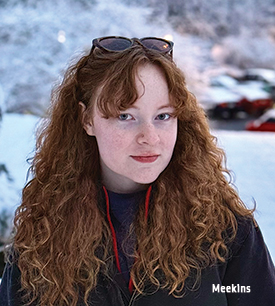
“I’m happy that we were able to be the pilot group for what is now a truly amazing scholarship,” says Dorian Meekins ’26. “While the HOPE scholarship now is not the scholarship I received, it is something much better that will give much-needed opportunities.”
President Hinton witnessed the transformation firsthand.
“The regional HOPE scholarship enriches our classrooms with new perspectives and leadership and helps us build deeper relationships with the Roanoke Valley community,” Hinton explains. “HOPE shows what’s possible when we focus on student success and build durable connections across academic affairs, enrollment, and student support.”
 That promise came into focus through students like Ameena Alsmadi ’26.
Quiet and hesitant as a first-year student, Alsmadi, a business and psychology double major with a minor in economics, has emerged as a campus leader. A resident assistant, interfaith leader for Muslim students, and research coordinator for the psychology department’s Memory and Cognition Lab, her Hollins experience includes a coveted Amazon area manager internship and a January Term (J-Term) in Kenya studying women’s reproductive health.
“Before coming to Hollins, many people told me that although I wouldn’t be paying as much, I would be at a disadvantage due to Hollins’ size and lack of reputation compared to schools like Virginia Tech,” Alsmadi explains. “There are many mechanisms in place here, like J-term and signature internships, which help students connect to various opportunities.
“When I got here, I had many ideas and goals but lacked the confidence to try or trust myself,” Alsmadi says. “Hollins gave me the support and encouragement to trust my voice, share my perspectives, and step into leadership roles that once felt out of reach.”
Alsmadi’s transformation fills Hinton with pride. “Now Ameena walks around campus like she owns it — in all the very best ways,” she says. “HOPE has given young women who may not have had a chance an incredible opportunity to thrive on campus and beyond. That’s truly priceless to me.”
“The best surprise [about HOPE],” Alsmadi reflects, “is how many doors have opened for me.” This spring, she begins her career in industrial organizational psychology as a full-time Amazon area manager in Maryland.
WHY HOPE IS NEEDED NOW
Higher education is facing intense pressure. In 2026, a steep, long-anticipated demographic decline in the number of high school graduates begins, intensifying competition across states, even where projections are more favorable, explains Ashley Browning, M.A.L.S. ’13, vice president for enrollment management.
At the same time, applications have surged at large public universities since the pandemic, with decreasing enrollment at small liberal arts colleges. “Those are the places where applications are through the roof,” Browning says, “and it’s made things challenging for small private institutions.”
Another shift affects every college and university in the U.S.: limited-income, first-generation students and students of color now make up a growing share of the college-going population. At Hollins, the class of 2029 reflects that change, with 44% first-generation students and 67% Pell-eligible students (those meeting federal qualifications for need-based support based on limited family income).
National research underscores the stakes. In 2024, the Brookings Institute concluded that encouraging more academically talented, lower-income students to enroll at selective colleges could significantly increase equity and economic mobility. Yet because of the “excellence gap,” students from low-income backgrounds are eight times less likely to obtain a bachelor’s degree than higher-income peers.
Many institutions have responded by expanding access, often through loan-based aid. Few, however, match the scope of Hollins’ national HOPE program introduced in 2024 (the first cohort started in fall 2025), which covers tuition, on-campus food and housing, and required fees entirely loan-free.
For 2025-26, the standard direct cost to attend Hollins is $60,910. Even with aid, many students must juggle loans and jobs, borrowing that impacts everything from career paths to long-term financial security. The typical student debt load for graduates of private institutions hovers around $40,000 (Education Data Initiative), with much higher totals when private loans are involved.
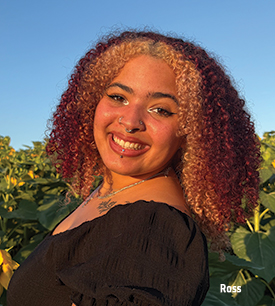
Deja Ross ’27, a Roanoke native and regional HOPE scholar, is proudly loan-free. “Having my tuition covered gave me a big advantage,” she says, allowing her to study abroad in Ireland while pursuing a demanding double major in elementary education and psychology.
“Students cannot choose education over food, housing, or caring for their families,” Ross adds. “HOPE allows them to pursue their education and still take care of their responsibilities.”
Affordability, Browning notes, has long been the top concern for students across income levels.
For years, Hollins was financially out of reach for many excellent students,” she says. “HOPE changed that.
Today, Hollins awards every new student at least $25,000 in merit scholarship support — a strong statement of our continued investment in all students.
Among women’s colleges, Hollins enrolls a notably high percentage of low-income students, an intentional, mission-driven, and future-focused choice. “There’s tremendous opportunity to better serve those who are coming to college,” Browning explains, “while advancing access, equity, and institutional sustainability.”
As a cornerstone of the university’s Transforming Learning, Transforming Lives: The Levavi Oculos Strategic Plan, HOPE represents a critical component of Hollins’ innovative answer to access and sustainability challenges, and its bold aspiration to lead nationally in social, economic, and civic mobility for women.
DESIGNED FOR BELONGING AND SUCCESS
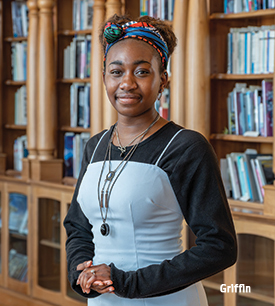 Hollins’ strength lies in creating an intentional environment that connects HOPE scholars to mentorship, belonging, and opportunity from the start.
Jessi Kingery, HOPE Scholars Transition Coach, begins working with students in February of their high school senior year and continues with individualized advising once they arrive to campus, helping them shape schedules, connect to opportunities, and build confidence early.
“Jessi really fosters and inspires us,” says Jahaziah Griffin ’29. Griffin also appreciates how seamlessly HOPE scholars are integrated into campus life. “No one asks if you are a HOPE scholar,” she explains. “I didn’t realize that five of my closest friends were also HOPE scholars until weeks into our relationship.”
HOPE scholars also benefit from what has defined Hollins for 184 years: close relationships with faculty. When Griffin arrived with her cello (a beloved gift from her grandmother), private lessons were not financially feasible. But Associate Professor of Music and Music Department Chair Shelbie Wahl-Fouts didn’t hesitate to invite her to take lessons, covered by financial support. Griffin and two classmates later founded Coda Noir, a chamber ensemble that now performs on campus.
Before HOPE, Griffin worried student debt would force her away from her dream of becoming an elementary school teacher. “HOPE allowed me to breathe by removing the financial stress,” she says. “It really changed the trajectory of all my plans.
“We’re incredibly competitive among the most academically talented students. A Hollins degree is even more valuable because of how the institution is thriving.”
“It’s a different mindset when I came here, because I can pursue what I want to pursue. Now, I set the limit on how far I want to go.” Next year, those opportunities include being a writing tutor, continuing to perform with Coda Noir, and getting involved with the fencing club, pickleball, and theater.
HOPE has strengthened Hollins’ competitiveness. “We’re incredibly competitive among the most academically talented students,” Hinton says. “A Hollins degree is even more valuable because of how the institution is thriving.”
Enrollment strategy, Browning emphasizes, is about balance. HOPE complements Hollins’ continued investment in robust merit scholarships while ensuring the university remains responsive to students and families across a wide range of income bands, including those with the capacity to pay. “If you’re an incredible student and feel called to our mission, we want you here, regardless of family resources,” she says.
National HOPE scholar Julia Cooper ’29, who plans to double major in biology and Spanish, chose Hollins for similar reasons. “Other scholarships didn’t include housing or meals,” she says. “Without HOPE, my family would be taking on loans we couldn’t manage.”
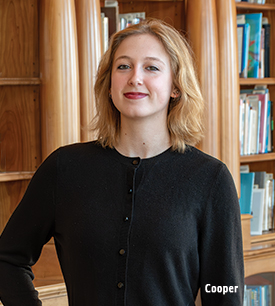 Opportunities to ride and study abroad sealed the decision. Cooper’s love of horses began on a church mission trip at a barn in upstate New York. After her second riding lesson, Sherri West, director of Hollins’ equestrian program and riding coach, asked if she’d like to join the team. “It felt like I was jumping right into a very loving and caring family,” Cooper recalls. “I came with no equipment, and teammates donated what I needed.” She took four lessons a week last fall, partially paid for by her job at the barn.
“Hollins is a small school, but the huge benefit is that I can really connect with my professors,” adds Cooper, who plans to attend medical school. “Classes are more discussion-based, and since HOPE assists study abroad, I can do research in Ireland or Spain without worrying about the cost. When you are always worrying about your next bill, your mind tends to be closed off. HOPE gives me possibilities.”
Making the impossible possible is what Hollins has always done, Hinton reflects. “Every person I know is seeking hope right now,” she says. “And we actually have it living and breathing on our campus. No other institution is doing what Hollins is doing through HOPE.”
Hollins’ vision honors its leadership tradition as a women’s college while transforming the future of every person on campus and beyond. “HOPE is making a tangible difference in the lives of each student, their families, their communities, and every life they will touch,” she reflects.
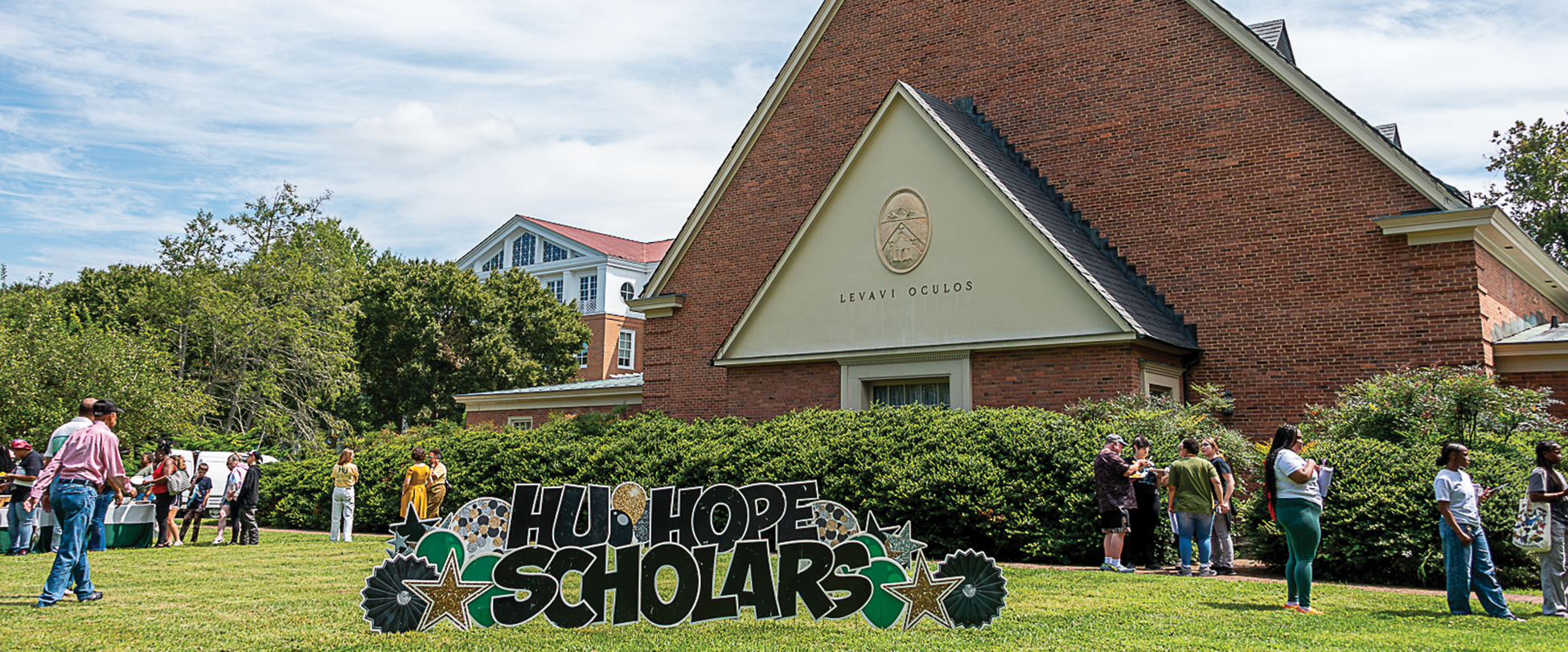
ENSURING HOPE
HOPE is an ambitious promise, and Hollins is committed to sustaining it for generations.
To ensure that limited-income women will always have access to a Hollins education, the university is building a $125 million HOPE endowment. To launch the national program, Hollins raised $10 million to fully fund the first two HOPE classes for four years. The university is now raising an additional $10 million to support the incoming classes of 2027 and 2028.
As the demographic of college-bound students shifts, so too does the philanthropic landscape. Anita Branch-Brown, vice president of institutional advancement, points to a coming “philanthropic cliff” as long-standing donors age. “That generation is slowly leaving us,” she explains. “Another generation paid full freight and may still be carrying student loan debt. Now, we’re welcoming a generation of women whose education at Hollins comes at no cost.”
With that gift comes an expectation: pay it forward.
HOPE scholar Jahaziah Griffin ’29 embraces that responsibility. “I’m even more dedicated to my education because I’ve been given this opportunity,” she says. “My friends who are HOPE scholars want to pour back into the community and the people who made this possible.”
MATCHING CHALLENGE
Thanks to a generous $2 million challenge match from Anonymous Trust, gifts to the HOPE Scholarship have the potential to be doubled, dollar for dollar. This is an all-or-nothing matching challenge: the full
$2 million must be raised by June 30, 2026, or none of the matching funds will be released.
The match applies to gifts made to either the HOPE endowment or the HOPE current-use initiative, which supports the next classes of HOPE Scholars. Through June 30, 2026, qualifying gifts will be matched dollar for dollar once the full $2 million challenge goal is met. Eligible gifts include:
• Gifts from new donors to HOPE,
• Gifts from lapsed donors who have not given to HOPE in the past 18 months, and
• Increased gifts from current HOPE donors.
For more information about the challenge match, contact Anita Branch-Brown at branchbrownar@hollins.edu.
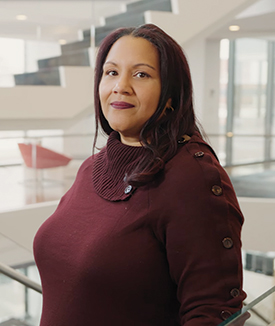
BEFORE HOPE HAD A NAME
 Scan the QR code to watch “Love, Sabrina,” a video love letter from Hollins Trustee Sabrina Rose-Smith ’00 to her younger self. Raised in the projects of Birmingham, Alabama, Sabrina was a promising young woman with the intellect, ambition, and determination to succeed, but she believed college was out of reach. A chance encounter at a college fair changed everything, opening the door to possibility, education, and a future she once thought unattainable.
Like HOPE scholars, Sabrina’s story is a powerful reminder of what happens when an unstoppable young woman is given the opportunity to pursue her dreams.