
Hollins Riding: Tradition and Teamwork in Every Ride
by Sarah Achenbach ’88
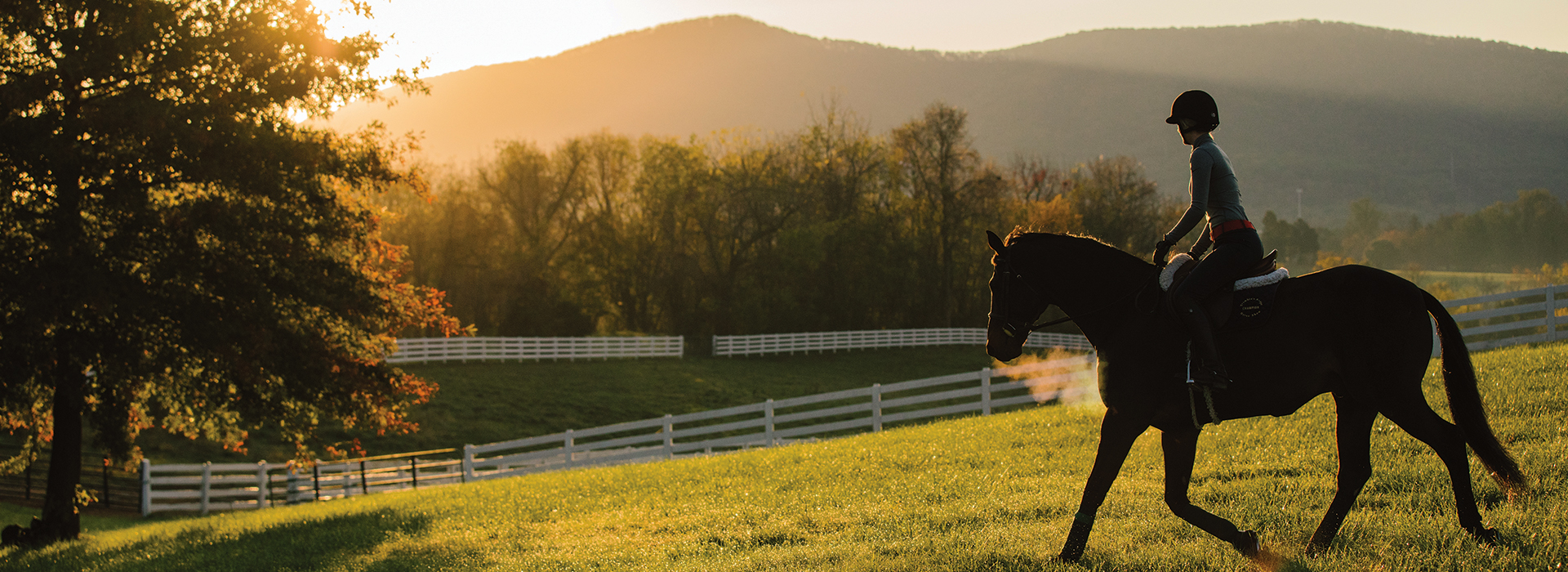
Photo: Madeleine Lohr ’19, an accomplished Hollins rider, won multiple awards at riding events during her time at the university.
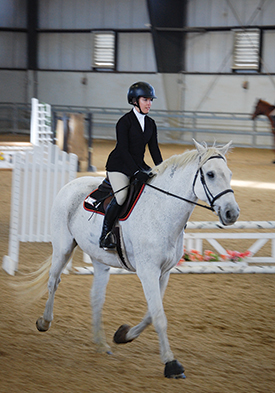
Hannah Mae Schmidt ’28
A pair of stirrups nearly derailed Hannah Mae Schmidt’s ’28 debut.
The Hollins sophomore had expected to compete early in the day for her first Intercollegiate Horse Show Association (IHSA) competition on Nov. 8 at Virginia Tech. Instead, a last-minute stirrup adjustment (her irons were too long) pushed her to the end of the Novice Flat class. Around her, teammates moved in without being asked, rolling leathers and checking tack while Head Riding Coach Sherri West offered calm reassurance.
Schmidt faced another reality to manage, too: she had drawn her horse at random, as all IHSA riders do.
Then she entered the ring. Last in her class, but ready.
“I was strangely calm during the whole ride and super confident in my abilities,” Schmidt recalls. Months of preparation took over. When she finished and dismounted, West pulled her into a hug as teammates erupted in cheers. Moments later, the results were announced: second in Novice Flat, an incredible finish for her first competition.
“Riding is my favorite thing in the world,” she says. “Competing is just a bonus.”
Schmidt has ridden non-competitively since age seven, but her path to the competition roster wasn’t immediate. After trying out her first year at Hollins, Schmidt was placed on the Practice Squad.
“I wasn’t ready physically or mentally,” she admits. But she stayed. She practiced. She volunteered. She learned. “Hollins has lots of opportunities, and I take every single one.”
She earned the A team spot she wanted the following year. Last fall, she built a schedule that would intimidate most seasoned athletes: practice at 5:30 a.m. two days a week, lessons on two other days, team practice on Fridays, and most weekends spent helping with IHSA events or the Interscholastic Equestrian Association shows Hollins hosts for middle and high school students. She did it while maintaining a 3.9 GPA.
What Schmidt accomplished is the goal for every Hollins rider — from the elite competitor to the student who first discovers riding for the first time: to face challenge, adapt in real time, and come out stronger.
The Gold Standard, Then and Now
Our mission is to help riders realize their potential,” says West. “And that looks different for every rider.”
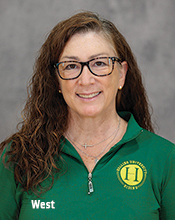
West grew up riding in Roanoke, knowing that “Hollins was the gold standard.” She took the reins of the program in 2018.
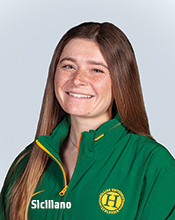
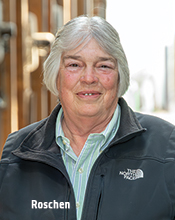
 With West at the helm, and with Maggie Siciliano, assistant riding coach and recruiting coordinator; Liz Courter, associate head coach (recently retired after 40-plus years coaching at Hollins); and Elise Roschen, now in her fourth decade as Riding Center manager, Hollins has continued to deliver results at the highest levels. T he team has earned numerous regional and national IHSA titles, including a sixth-place team f inish at the 2024 IHSA National Championship. Individual riders have placed consistently at regional and national shows, carried by a culture that treats excellence as something shared.
“Hannah Mae is the poster child for what is possible if you put forth the hard work and effort and take advantage of the resources around you,” West says.
Those resources are remarkable. Long known as one of the top collegiate riding programs in the country, Hollins supports riders with a premier 43-stall Riding Center that includes a 220-by-110foot indoor arena featuring new, state-of-the-art GGT footing, an updated outdoor ring, seven pastures, and a six-horse Equicizer, an equine walker with a central lunging space. The entire facility sits at the heart of campus life. The barn isn’t an off-site destination; it’s part of the daily rhythm of the Hollins community.
NCEA and More Opportunity
Dudley Wood MacFarlane ’77
The long-standing Hollins riding tradition is expanding again.
In fall 2026, Hollins elite riders will compete as a single-discipline Jumping Seat team in the National Collegiate Equestrian Association (NCEA), becoming the 10th program of its kind in the NCEA and the sixth NCAA Division III institution to adopt the format. Competition includes Berry, Bridgewater, Centenary, Dartmouth, Lynchburg, Sacred Heart, Sewanee, and Sweet Briar.
 Hollins will continue competing in IHSA, where it has been a fixture since 1974. The two formats support two important truths about Hollins riding: the program can compete at the highest level, and it can make riding accessible across experience levels. Unlike the NCEA, which is designed for elite collegiate competition, IHSA riders from programs of all sizes compete in the same framework. Riders draw horses at random. Adaptability and horsemanship matter as much as polish.
“We’re adding NCEA to provide students more opportunities and to address the recruiting landscape that’s changed over the last 20 years,” West explains, referencing the growth of NCAA and women’s equestrian programs.
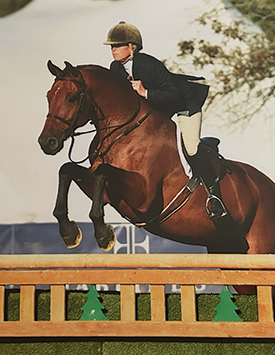
Dudley Wood Macfarlane ’77, now a champion amateur owner hunter who competes nationally, remembers the program before IHSA.
 “We did fox hunting or went to local shows on Hollins horses,” she recalls. “The NCEA is a great move for Hollins.”
The program’s growth over time has supported riders like Heide Bossow-Casciaro ’88, one of the most decorated riders in program history. She’s a two-time Cacchione Cup winner, IHSA’s highest individual honor (formerly named the Fitch Trophy and often likened to the Heisman Trophy). Bossow-Casciaro chose Hollins because it allowed her to compete at the top level while receiving the education she wanted.
“The smaller community and small student-to-professor ratio were right for me,” she says. “You couldn’t put your baseball cap on and sit in an auditorium of 500 people and not be called on. Hollins’ liberal arts education diversifies you — it opens doors.”
Today, Bossow-Casciaro is the founder and owner of Tievoli Farm in Woodstock, Illinois, where she trains riders from Short Stirrup to Grand Prix. At just 10 years old, she won the Illinois Hunter Jumper Association (IHJA) Medal Finals. She has served as IHJA past president and current  board member and will be one of the judges for the 2026 IHSA National Championship in Tryon, North Carolina, in May 2026.
“Riding teaches you how to manage risk and uncertainty,” she says. “That stays with you.”
One Barn, Many Journeys
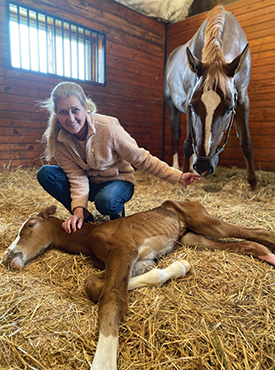
Heide Bossow-Casciaro ’88
For Bossow-Casciaro, who was inducted into the Hollins Athletic Hall of Fame in 1995, the joy of competing was doing so as a team and as an individual. As Hollins adds NCEA, having two distinct levels of competition won’t change what riders describe as the program’s defining strength: a place for everyone, supported at every level.
“Hollins is special because IHSA is still treated as a varsity sport,” says Gigi Goshtigian ’26, a four-year team member and All-ODAC honoree. “Some schools are dropping both IHSA and NCEA teams. Hollins isn’t.”
“You’ve got the person who just started riding three months ago and elite riders,” West adds, and “being part of the same program is the glue that holds them together.”
At some IHSA schools, riders may not spend much time together outside the varsity roster. Not at Hollins. All riders share one facility, which develops friendships and peer mentoring. They volunteer at Hollins Student Athletic Association events and enjoy riding team activities.
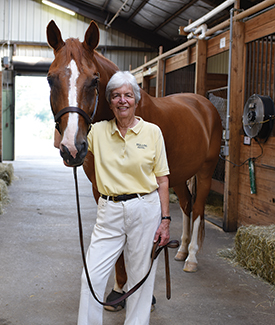
Nancy Peterson
 When Margaret Wise Brown ’32, a passionate horsewoman, arrived at Hollins in fall 1927, she was dismayed at the school’s run-down stables, according to In the Great Green Room: The Brilliant and Bold Life of Margaret Wise Brown by Amy Gary. Brown lobbied to start a riding club, and her mother, Maude Johnson Brown ’02, and father helped financially support improvements to the barn, then near the old dairy farm (by the campus silo). Hollins launched the riding program in earnest in 1930, quickly growing to 18 students in its first year. (Unlimited riding for the school year cost $75 in 1933.)
 The lower barn near Siberia (the outer parking lot by the courts) and a nearby outdoor ring served as Hollins’ riding facility until 1955-56, when a 28-stall barn with outdoor and schooling rings was constructed on a hill overlooking campus. In 1959, the gentle Guy “Red” Burkholder, “Mr. B.” to students, became director of riding. Each summer, he and the Hollins horses, along with then-assistant director Nancy Peterson and several Hollins riders, decamped to Maine for Burkholder’s riding camp.
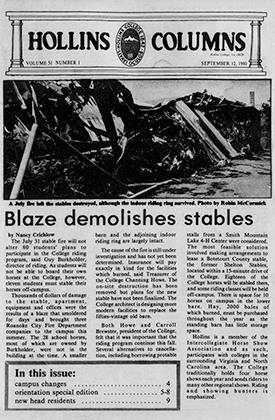 In the summer of 1980, with the barn vacant, a fire destroyed a large portion of the Hollins facility. Hollins refused to pause the riding program. Riders rallied with the old, six-stall barn down the hill and a rented barn and small ring in Botetourt County for boarding and lessons.
“Everybody worked together, and we kept going,” recalls Paget Hirsch Bennett ’81, now a sales manager for the Fastig-Tipton, the nation’s oldest thoroughbred horse auction.
A year later, the indoor ring, which had escaped the blaze, was converted using fire-retardant lumber into today’s stables, tack room, offices, and other amenities. In 1983, the new indoor ring and viewing lounge were completed, the same year as Hollins’ first IHSA Nationals appearance. Renamed the Kirby Indoor Ring in 1985, the expansive arena includes the Burkholder Lounge in honor of Mr. B.’s retirement.
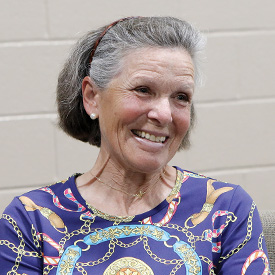
Paget Hirsch Bennet ’81
That year, Peterson became director, bringing Roschen with her as a groom and stable manager. Peterson would shepherd the program to its next level, retiring in 2018. When Roschen arrived, there was “one syringe and one needle in the whole place,” she recalls. For four decades, her knowledge, steady kindness, and high standards have elevated the care of the Hollins horses and the horsemanship of the riders. In both NCEA and IHSA
competitions, riders draw horses at random, and thanks to the quality of donated horses and Roschen’s expert care, Hollins horses are renowned at regional and national events.
And competitions aren’t just about ribbons. “It’s about building responsibility, self-reliance, and problem-solving,” Peterson once said. Her guiding principle — create a competitive program on the outside, not on the inside — remains central at Hollins. West continues that legacy today.
Belonging From Day One
Convinced she had to be recruited to ride on a college team, novice Sadie Henshaw ’28 assumed she would take lessons and nothing more. During her admissions tour, Henshaw learned she could be part of the team. Two days before the other first-year students arrived, she moved into Tinker dormitory and attended her first Hollins event: a riding team bonding activity.
“I immediately had 30 new best friends,” Henshaw laughs.
“I was scared because I knew Hollins’ riding pedigree and thought there would be a hierarchy,” she says. “But that’s not true at all.” Teammates taught her what she didn’t know about horse care, “which was a lot,” she admits — and she’s already paying it forward with a first-time rider on her hall. “We talk about her lessons and the horses.”
“You can be whoever you want on this team,” Schmidt adds. “You can take lessons for recreation or be on the Practice Squad and not compete. Or you can compete here or outside of Hollins. There’s so much I’ve learned from all the riders and even more to learn from the NCEA riders.”
What Riders Carry Forward
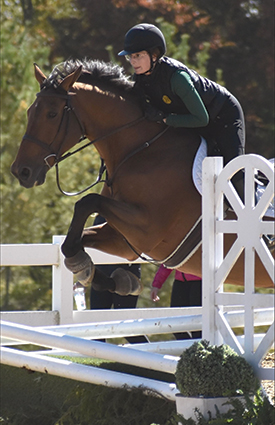 “The barn was a place where friends came together early in the morning and late at night,” reflects Maria Shannon ’96, a professional trainer, rider, and teacher at the national and international level and co-owner of The Barracks Farm, her family’s business in Charlottesville. “It grounded the work I was doing in class with something physical, practical, and collaborative.”
 That connectedness paid off. During Shannon’s four years on the Hollins riding team, she and her teammates won four straight ODAC championships and the National Championship in Open Equitation Over Fences in 1994. She was named ODAC Rider of the Year three times and won the individual Open Equitation Over Fences title in 1993 and 1995. She’s a double Hollins Athletics Hall of Fame inductee, recognized individually in 2010 and as part of the 1993 National Champion team, the first Hollins team in any sport to be inducted.
Shannon says IHSA competition teaches adaptability, preparation, and resilience, especially because riders compete on horses they’ve never ridden before.
“You learn to deal with the ups and downs, work with teammates and coaches, and show up consistently even when things are hard or unpredictable,” she says.
Goshtigian, who is applying to graduate programs in social work, credits the program with teaching her how to work with many personalities and roles.
“It takes a village, especially on the scale needed for shows to run smoothly,” she explains. That means 5 a.m. at the Riding Center cleaning tack and stalls, setting equipment, and preparing the ring. “Riding has really taught me what teamwork is, especially because collegiate riding can be very individual.”
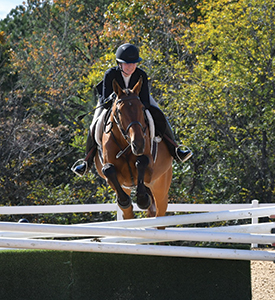
Gigi Goshtigian ‘26
 “For some, riding is not always accessible,” she adds. “So, for it to be accessible to the Hollins community through physical education classes and the team is amazing. College is where you should try new things, and the barn is a public place. Anyone can come up and pet the horses, hang out, and enjoy their presence.”
A self-described “barn rat,” Sarah Jarosinski Holy ’12, Doctor of Veterinary Medicine board-certified in Veterinary Anesthesia and Analgesia, earned an equally impressive list of Hollins ribbons. Co-president of the riding club for two years, Jarosinski Holy was IHSA Nationals Reserve Champion in 2011 in Novice Fences, earned All-ODAC honors, and was a member of the 2011 ODAC Champion Team and the 2012 ODAC Reserve Champion Team.
Prior to Hollins, Jarosinski Holy had only competed as an individual.
“In IHSA, everyone plays an important role, even the really green riders in walk-trot,” she says. “It leveled the playing field, and it was so fun to have the whole team on the rail cheering.”
She also found support for her academic ambition.
“There are many schools with equestrian programs,” she says, “but I found the balance between my academic and athletic goals at Hollins.”
When she had morning practice, team members or Roschen would untack and put away her horse. Another teammate helped get her to Dana Science Building in time for class. Her time management skills allowed her to pursue student government, tutor on campus, and commute frequently to Lexington to ride her own horse.
One teammate’s photo still graces the lock screen on Jarosinski Holy’s phone: Tres Coronas, the Hollins horse she rode for most of her college career.
The Horses at the Center
“The quality of Hollins’ donated horses has been a constant across generations.
“Hollins had and has great horses,” Macfarlane adds. “It’s important to learn to ride anything you sit on. Mr. B. taught me to feel a horse. It’s not a car. It’s a living, 1,200-lb. being you have to have a relationship with.”
Today, the Riding Center houses 30 horses, 22 owned by Hollins.
“We have a tradition of exceptional donated horses,” Roschen says. “Sometimes it takes a bit to figure out what they need — more turnout, more playtime, a specific ride. And then they become this wonderful addition to the program.”
Competing and recruiting at the NCEA level creates new opportunities for donations, Roschen adds. “That expansion is going to need to be reflected in the horses as well.”
 “The horses are really loved here,” Henshaw says. One of her favorite traditions is the twice-monthly Adopt-a-Horse program, in which every Hollins rider “adopts” a horse, grooming, bathing, grazing, and bringing treats. Her favorite is My Way, a warmblood. He’s also President Mary Dana Hinton’s favorite. She often visits him
during her commute from the President’s house across the road from the Riding Center.
“I tell every rider to listen to the horses because they have so much to teach,” West says. “When riders aren’t opening their ears to what the horses are saying nonverbally, they miss part of that conversation. Horses are truly magical creatures. I want every rider to maximize their capabilities and learn to love and respect the horses.”
“You have to accept early on that it’s not about you. It’s about the horse,” Henshaw says. “Coach West tells us that every horse has something to teach us.”
The discipline and adaptability she has developed — learning to maintain her position regardless of which horse she draws in competition — will serve her well in medical school, where she hopes to become an OB/GYN or pediatrician. “Riding is great for my academics,” she adds.
Learning to trust the horse has taught Schmidt to trust herself.
“Patience is key,” she says, something she expects to draw on in her dream career in occupational therapy, working with dysregulated children. “My goal is to keep improving, keep learning, keep having fun, and keep supporting my teammates, but also stay humble, with an open mind and an open heart.”
“It’s a new, exciting chapter for Hollins riding,” Roschen adds. “We’re eager to dig our heels in and come out on top.”
West knows that a learning curve with the new NCEA format is inevitable.
“But our goal is simple,” she says. “We want riders to seek out Hollins, where we give them the tools they need to ride exceptional horses and show excellence in everything we do.”